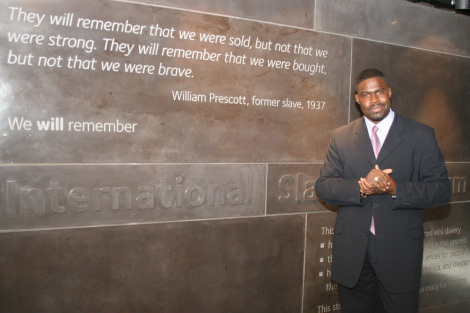
Garth Dallas
Riots In Britain
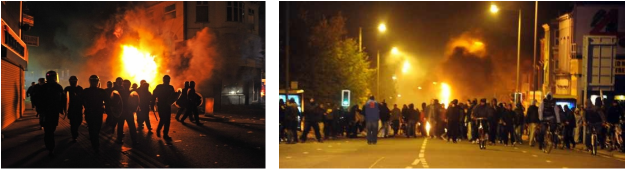
Photos provided by Garth Dallas

I have had a working relationship with Garth Dallas for nearly two years, thanks to technology and the marvels of Google and social networking.  So when the riots broke out nearly three weeks ago in Britain, Garth, who lives and works in Liverpool, was there to give an accurate perspective on what was really going on in England.

I lived through the 1967 riots in Detroit, Michigan and vividly remember how afraid my family was with the possibility of losing our house to fire.  So I can only imagine the fear some residents are experiencing with this recent outbreak in England.

Here is Part One of this important "insider's perspective" on what's really going on in Britain.

-Carole

======

Only last month (July) I was heavily involved in commemorating the 30th anniversary of the Toxteth Riots of 1981 which represented a significant moment in Liverpool’s history: petrol bomb attacks, milk-floats driven at the police, the burning and looting of shops, the first use of CS gas on mainland Britain, the running down by a police vehicle of a disabled youth were just some of the incidents. I didn’t experience the 1981 riots because I was still living in Jamaica at that time and was graduating High School when the riots erupted in Liverpool. Indeed, I returned to Jamaica in July to celebrate the 30th anniversary of our graduation and came back to England on the very same day that the 2011 Tottenham riots started – August 6th 2011.

 Masked youth wandered the streets armed with Molotov cocktails, families flee as their homes erupt in flames, medics tend to the bloodied and bruised as armoured vehicles patrol the streets - a scene fit for a war zone. The world has been captivated by the scenes emerging from London, Birmingham, Manchester, and Liverpool during the 7 days of rioting that rocked Britain while the British public has searched for explanations for what set off this wave of anarchy. 

  The spark in Tottenham was the killing of 29-year-old Mark Duggan on the evening of August 4th by police officers who stopped a minicab carrying him near Tottenham Hale Tube station to carry out a pre-planned arrest. Shots were fired, according to the Independent Police Complaints Commission, leading to Duggan’s death at the scene.

But shocking as the violence has been, this isn’t the first time England has been paralysed by riots - history seems to be repeating itself with terrifying accuracy.

 St. Paul’s Riot

In April of 1980, the Black and White Café, a famous drug den in Bristol, was raided by officers. High unemployment, poor living conditions and a general feeling of discrimination by the police force proved a deadly combination as over a hundred youth battled with officers, destroying police cars and fire trucks as well as local buildings.

In total twenty-five people were hospitalised, including 19 officers, and 130 were arrested. While the numbers were relatively low compared to later riots, St. Paul’s would be seen as a turning point.

1981 Summer Riots

The “Sus” law - short for suspected person - was a police method that allowed individuals to be stopped and searched without just cause, generating a harsh division between the police and minority communities in the late 1970s and early 1980s. April marked the introduction of a new tactic, called Operation Swamp, where police patrolled the streets in large groups, arresting thousands of suspected criminals in order to slash the crime rate. 

On the evening of April 10 in Brixton (London), as officers led a young black man suffering from stab wounds to a police car to take him to a hospital, he broke free, fearing he was actually being arrested. A crowd began to form around the scene, throwing bottles and bricks at the policemen. As the night went on, rumours spread like wildfire throughout Brixton that the injured man had actually been stabbed by the White officers.

Operation Swamp searches ensued and when officers attempt to search a man suspected of carrying drugs, a full-fledged riot broke with Molotov cocktails being thrown for the first time on the mainland in British history. Hundreds of homes and buildings were looted and torched. 300 officers were injured, along with 60 civilians. Riots spread to areas of Birmingham, Leeds and Liverpool in the later months.

 In Toxteth in Liverpool, for example, unrest was triggered in 1981 after police pursued a man they wrongly suspected had stolen a motorbike, and then arrested a nearby person for assault when he attempted to intervene. The unrest led to 450 police officers being injured and 70 buildings being demolished.

Broadwater Farm

On October 5, 1985, police raided the home of Cynthia Jarrett, a woman of African-Caribbean descent whose son had just been arrested. She lived on the Broadwater Farm estate, a dense housing unit in Tottenham, once known as one of the worst places to live in England. As police searched the woman’s house, she collapsed and died of a heart attack, prompting public outcry in the community. Cynthia Jarrett’s daughter reported that police officers pushed her mother to the ground. The following day, relatives led a peaceful protest to the police station in Tottenham, but the peace didn’t last long.

Hundreds of people began to riot, angered not only by Cynthia Jarrett’s death, but also the police shooting of an innocent Jamaican woman at her home in South London a week earlier, leaving her paralyzed from the waist down. A string of looting, violence against journalists and armed confrontations with police ended with the brutal death of police constable, Keith Blakelock, who was stabbed 42 times as rioters tried to decapitate him with machetes. For months after the incident, hundreds of people were arrested and interrogated.

End of Part One.  Your Comments Are Welcome.  Stay Tuned For Part Two Tomorrow


Garth Dallas is CEO of Global Diversity Partners, Editor of Diverse Magazine and Chair of African Caribbean Business Support Group. He has over 17 years corporate, agency and entrepreneurial experience in Global Diversity Management, Business Development, Marketing and International Business Relations with clients in the public and private sectors. He lives in Liverpool, England.

For more information on Garth Dallas, visit his website at  www.diversemag.co.uk